Can a sleep tracking ring detect sleep apnea? Know the limits

A consumer sleep tracking ring cannot diagnose or rule out sleep apnea; diagnosis requires a clinical evaluation and appropriate sleep testing. Blood oxygen estimates and disrupted sleep patterns are not proof of a breathing disorder, and reassuring readings do not exclude one. This 2026 guide explains what ring data means, when to seek medical care, and where everyday wellness tracking stops.
- Odessa Ring is best for subscription-free everyday sleep insights, not sleep apnea detection.
- For sleep tracking ring sleep apnea questions, oxygen estimates cannot confirm or exclude a breathing disorder.
- Witnessed breathing pauses, nighttime gasping, and persistent daytime sleepiness warrant medical evaluation regardless of your sleep score.
- Home sleep apnea testing and laboratory sleep studies serve different patients; a clinician chooses the appropriate test.
Interactive · Metric explorer
Tap to explore what Odessa tracks

Sleep: how long and how well you slept, worked out from movement and heart rate overnight.
Heart rate: readings through the day and night from the optical sensor on the inside of the band.
HRV (heart rate variability): the variation between heartbeats, a signal many people watch for recovery trends.
SpO2: blood-oxygen estimates for general wellness, not medical use.
Stress: estimated from body signals such as HRV, so you can see calmer and busier stretches.
Skin temperature: changes against your own baseline over time.
Steps: steps, distance and calories, with sport modes for walking, running, cycling, swimming and more.
Cycle: log your cycle alongside the rest of your data to spot your own patterns.
What it doesn't do: it doesn't measure blood pressure, it doesn't detect snoring, and it doesn't diagnose, treat or prevent any condition. It's a wellness tracker, not a medical device.
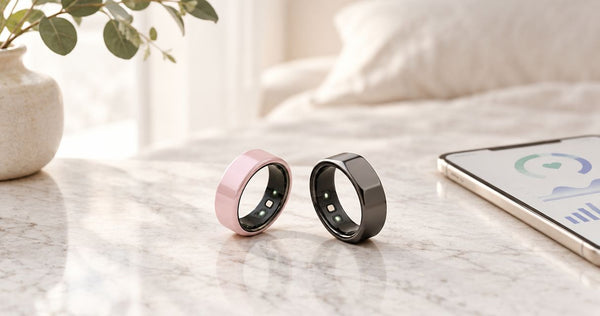
Real product photo. Sensor positions are approximate. Battery: 5–7 days per charge. Free app, no subscription.
Why this matters
A good sleep score is not medical clearance. If someone notices that you stop breathing during sleep, an app summary does not cancel that observation. The same applies when you repeatedly wake gasping or struggle to stay awake during the day.
The Odessa Smart Ring offers subscription-free sleep and wellness estimates through the free QRing app for iPhone and Android. Those insights serve a different purpose from medical testing. Knowing that difference helps you choose a ring without buying into a diagnostic claim it does not make.
Can a sleep tracking ring detect sleep apnea?
A consumer wellness ring cannot establish a sleep apnea diagnosis. It can record estimates that give you something to discuss with a clinician, but a pattern in an app does not identify its cause. An oxygen dip, a restless night, or a change in heart rate needs context.
For a 2026 buying decision, separate everyday tracking from a clinician-directed diagnostic pathway:
| Approach | Best for | What it contributes | Main limitation |
|---|---|---|---|
| Consumer wellness ring | Everyday sleep and wellness awareness | Estimated sleep patterns and supported wellness readings | Cannot confirm or exclude sleep apnea |
| Clinician-ordered home sleep apnea test | Selected adults whose clinical evaluation supports home testing | Breathing-related measurements collected at home | Not appropriate for every patient; a negative result sometimes requires laboratory testing |
| Laboratory polysomnography | Diagnostic assessment when a clinician recommends laboratory testing | Multiple signals, including sleep and breathing measurements | Requires an arranged study rather than ordinary nightly wear |
The American Academy of Sleep Medicine's Clinical Practice Guideline for Diagnostic Testing for Adult Obstructive Sleep Apnea recommends polysomnography or technically adequate home testing for appropriate patients. It also recommends laboratory testing after a negative, inconclusive, or technically inadequate home test when evaluating suspected obstructive sleep apnea.
That guidance concerns diagnostic testing in adults, not the accuracy of a particular consumer ring. A product measuring some familiar signals does not automatically meet those diagnostic requirements.
Does a sleep apnea feature change the answer?
A device-specific screening feature must be assessed on its own authorization, intended users, and instructions. Do not transfer a claim from a watch to a ring, from one model to another, or from one country's authorization to another market.
Screening and diagnosis are different claims. Before relying on a feature, check the exact model and its official documentation. A general promise to track oxygen or sleep is not evidence that the device detects sleep apnea.
What blood oxygen estimates can—and cannot—tell you
Blood oxygen estimates can draw your attention to a pattern. They cannot explain why that pattern occurred. Sleep apnea is one possible clinical concern, but an isolated low estimate is not a diagnosis.
The US Food and Drug Administration's Pulse Oximeters guidance explains that readings have limitations. Factors including poor circulation, skin pigmentation, skin temperature, and other measurement conditions affect accuracy. That guidance addresses pulse oximetry generally; it does not establish the accuracy of Odessa Ring.
Do not use a consumer ring reading as a reason to dismiss symptoms. Equally, do not interpret an unexpected value as proof that you have a medical condition. Discuss recurrent concerns with a healthcare professional, who can decide whether testing is appropriate.
A single oxygen summary also does not show every signal a clinician needs. Diagnostic sleep testing evaluates breathing-related events using the measurements and scoring rules appropriate to that test. A wellness app's sleep score is not interchangeable with that assessment.
Why ring readings and medical findings differ
Differences are not automatically evidence that either device is defective. Consumer tracking and diagnostic testing answer different questions, and their methods are not interchangeable.
- Intended purpose: Everyday wellness tracking describes patterns; diagnostic testing evaluates a suspected condition.
- Signals collected: A consumer ring does not necessarily collect the airflow, breathing effort, and sleep signals used in clinical testing.
- Measurement conditions: Temperature, circulation, movement, and sensor contact affect optical measurements.
- Analysis method: App estimates and clinical scoring apply different methods. Similar labels do not prove equivalent results.
- Clinical context: Symptoms, medical history, medications, and other health conditions influence how a clinician interprets findings.
- The night measured: Sleep and breathing vary between nights. One reassuring night cannot settle an ongoing concern.
These factors explain why the right question in 2026 is not simply whether a ring displays oxygen. Ask what its measurements are intended to support, what validation exists for that exact device, and whether your symptoms need medical assessment.
 Screen-free · No subscriptionOdessa Smart RingShop the ring →
What should you do if you suspect sleep apnea?
Arrange a medical evaluation rather than waiting for a ring to confirm your concern. The National Heart, Lung, and Blood Institute's Sleep Apnea Symptoms guidance identifies breathing pauses, loud snoring, gasping, and daytime sleepiness among the signs to discuss with a healthcare professional.
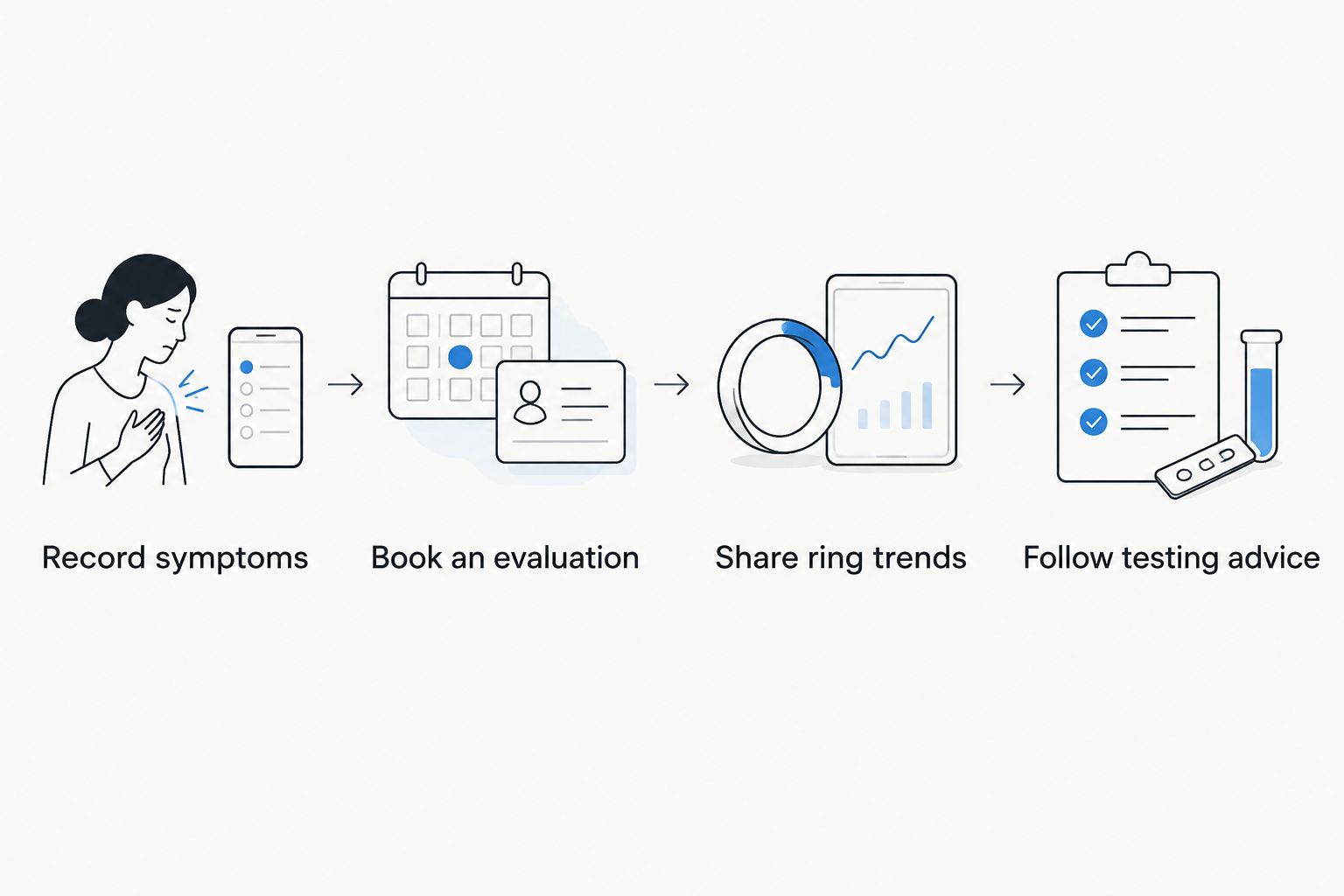
Use this sequence to make that conversation useful:
- Record symptoms. Write down gasping, witnessed pauses, morning headaches, unrefreshing sleep, or difficulty staying awake. Include observations from a bed partner when available.
- Book an evaluation. Describe the symptoms and how they affect daily life. Bring relevant medical history and a medication list.
- Share ring trends. Show the dates and patterns that concern you, without presenting the app's interpretation as a diagnosis.
- Follow testing advice. Complete the home or laboratory test your clinician recommends, and discuss what the result means.
You do not need an abnormal ring reading before booking an appointment. Symptoms are enough to start the discussion. If sleepiness makes driving unsafe, do not drive; seek medical advice rather than trying to override the problem with an app score.
Is a home sleep apnea test enough?
A home sleep apnea test is appropriate for selected adults after clinical evaluation. It is not simply any wearable used while you sleep, and buying a consumer ring does not turn ordinary nightly tracking into a prescribed home test.
The American Academy of Sleep Medicine's diagnostic guideline supports home testing in uncomplicated adults with signs and symptoms indicating an increased risk of moderate to severe obstructive sleep apnea. It recommends laboratory polysomnography instead for several situations, including significant cardiorespiratory disease, suspected sleep-related hypoventilation, chronic opioid use, a history of stroke, or severe insomnia.
A negative home test does not always end the evaluation. The same guideline recommends polysomnography when a home test is negative, inconclusive, or technically inadequate. Your clinician decides how that recommendation applies to your symptoms and history.
What does Odessa Ring offer instead?
Odessa Ring is best for women who want subscription-free everyday sleep insights, not sleep apnea detection. Its role is simple: screen-free wear paired with an app that shows estimated sleep and wellness information. It is not intended to diagnose, treat, or monitor a medical condition.
The product information supplied for this 2026 guide includes sleep, heart rate, stress, blood oxygen estimates, skin temperature, and activity. The free QRing app supports iPhone and Android. Those features describe what you can view; they do not establish clinical accuracy or equivalence to another device.
The advantage is everyday access without a monthly subscription. The limitation is equally clear: you cannot use the ring to confirm apnea, exclude apnea, or judge whether treatment is working. Choose it for awareness, not medical reassurance.
Fit and overnight comfort
Available sizing runs from US size 6 through US size 14. Confirm your size before ordering, and assess comfort during ordinary wear as well as overnight. A ring should not cause pain, numbness, or persistent skin irritation; remove it if it does.
The ring uses stainless steel and has no screen. That format suits shoppers who prefer jewelry-style tracking to a watch, but comfort remains personal. No specification guarantees that every wearer will find a ring comfortable throughout the night.
Charging and ownership terms
The client-confirmed battery specification is 5–7 days per charge. Plan charging around your routine rather than assuming that a missed night of data can be reconstructed later. The ring and charging cable are included.
Ownership terms include 60-day returns with worn rings accepted, free size exchanges within 60 days, and a 12-month manufacturing-defect warranty. Change-of-mind return postage is the customer's responsibility. There is no monthly subscription, but check the current purchase total and applicable delivery terms before ordering.
Some site pages display conflicting battery and return language. The client-confirmed specifications used in this 2026 guide are 5–7 days per charge and 60-day returns with worn rings accepted. Request written clarification if the terms shown during your purchase differ.
How should you use sleep trends without overreading them?
Use your ring to observe your routine, not to assign yourself a diagnosis. Notice bedtime consistency, estimated sleep duration, and how you feel on waking. Keep symptoms separate from the app's score so neither gets lost in the other.
For example, a reassuring score alongside persistent daytime sleepiness still deserves attention. A poor score after an obviously disrupted night does not identify a breathing disorder. The practical value is the pattern you can describe, not a medical conclusion you draw from it.
During 2026, evaluate new sleep features with the same standard: evidence must match the exact product and the exact claim. Research about wearable devices generally cannot establish that this ring detects apnea. A familiar-looking chart is not product-specific validation.
Frequently asked questions
Can a sleep tracking ring tell me if I have sleep apnea?
A consumer wellness ring cannot diagnose or rule out sleep apnea. Bring concerning symptoms and any relevant ring trends to a clinician, who can recommend appropriate testing.
Can normal oxygen readings mean I don't have sleep apnea?
Normal consumer-ring oxygen estimates do not exclude sleep apnea. Do not dismiss witnessed breathing pauses, gasping, or persistent daytime sleepiness because an app looks reassuring.
Does Odessa Ring detect or monitor sleep apnea?
Odessa Ring is not intended to diagnose, treat, or monitor sleep apnea or another medical condition. Its sleep and blood oxygen readings are wellness estimates.
Should I buy a ring before asking for a sleep apnea test?
You do not need to buy a ring before seeking a medical evaluation. Describe your symptoms directly; a clinician can decide whether home testing or a laboratory study is appropriate.
Is a home sleep apnea test the same as wearing a smart ring?
A clinician-ordered home sleep apnea test is not the same as ordinary consumer-ring tracking. Diagnostic testing follows a clinical pathway and uses equipment intended for that assessment.
What if my home sleep apnea test is negative but I still have symptoms?
Persistent symptoms after a negative home test need follow-up with your clinician. The American Academy of Sleep Medicine recommends laboratory polysomnography after a negative, inconclusive, or technically inadequate home test when evaluating suspected obstructive sleep apnea.
Does a better sleep score mean sleep apnea treatment is working?
A better consumer sleep score does not establish that sleep apnea treatment is working. Follow the monitoring and follow-up plan provided by your treating clinician rather than substituting wellness estimates.
One last thing
You do not need convincing wearable data to deserve a medical evaluation. A clear description of symptoms is more useful than waiting for the perfect screenshot. If your main goal is everyday sleep awareness, choose a ring on fit, app compatibility, subscription terms, and realistic expectations—not on an unsupported promise to detect apnea.