How accurate is a sleep tracking ring? Evidence and limits

A sleep tracking ring estimates sleep rather than measuring it the way a clinical sleep study does; its accuracy depends on the device, the metric and the person wearing it. Research on specific rings supports detecting sleep more reliably than detecting quiet wakefulness, but those results do not establish an accuracy percentage for the Odessa Smart Ring. In 2026, the useful buying question is whether you want everyday sleep trends without a subscription—not whether a ring can replace medical assessment.
- Sleep tracking ring accuracy is metric-specific: identifying sleep is different from correctly identifying wakefulness or sleep stages.
- Odessaring is best for women who want subscription-free sleep estimates, not medical sleep measurements.
- Research on an Oura model does not establish Odessa Smart Ring accuracy.
- Compare your sleep trends with your own experience; do not treat a sleep score as a diagnosis.
Interactive · Metric explorer
Tap to explore what Odessa tracks

Sleep: how long and how well you slept, worked out from movement and heart rate overnight.
Heart rate: readings through the day and night from the optical sensor on the inside of the band.
HRV (heart rate variability): the variation between heartbeats, a signal many people watch for recovery trends.
SpO2: blood-oxygen estimates for general wellness, not medical use.
Stress: estimated from body signals such as HRV, so you can see calmer and busier stretches.
Skin temperature: changes against your own baseline over time.
Steps: steps, distance and calories, with sport modes for walking, running, cycling, swimming and more.
Cycle: log your cycle alongside the rest of your data to spot your own patterns.
What it doesn't do: it doesn't measure blood pressure, it doesn't detect snoring, and it doesn't diagnose, treat or prevent any condition. It's a wellness tracker, not a medical device.
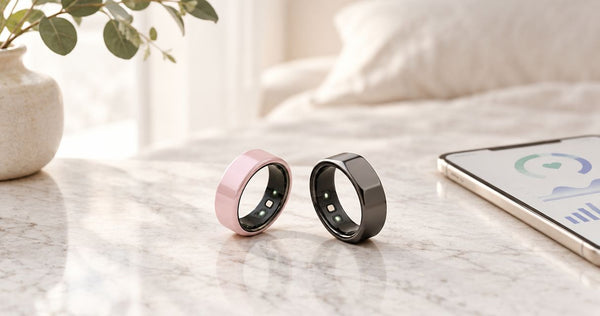
Real product photo. Sensor positions are approximate. Battery: 5–7 days per charge. Free app, no subscription.
How accurate is a sleep tracking ring?
There is no single accuracy percentage that describes everything a sleep ring reports. Detecting sleep, detecting wakefulness and assigning sleep stages are separate tasks. A device can perform well at one and poorly at another.
For a subscription-free option, the Odessa Smart Ring provides sleep and other estimated wellness readings through the free QRing app. Its feature list tells you what it reports, not how closely each result matches a clinical measurement.
| Measurement | What the result means | Useful for | Main limitation |
|---|---|---|---|
| Sleep detection | Classifying a period as asleep | Reviewing your estimated nightly sleep pattern | Quiet wakefulness can resemble sleep |
| Wake detection | Identifying time spent awake | Comparing reported interruptions with what you remember | Brief or motionless waking can be missed |
| Total sleep time | Adding up periods classified as sleep | Following changes across nights | Classification errors affect the total |
| Sleep stages | Assigning estimated sleep categories | Adding context to a nightly summary | A ring does not directly measure the brain activity used in clinical staging |
| Sleep score | Summarizing selected measurements | Getting a quick overview | A score is not a diagnosis or a standardized clinical measurement |
What published ring research actually shows
A study by de Zambotti and colleagues, published in Behavioral Sleep Medicine in 2019, compared an Oura ring with polysomnography in 41 healthy adolescents and young adults. The researchers reported 96% sensitivity for detecting sleep and 48% specificity for detecting wakefulness.
Those percentages describe different outcomes. The ring identified most periods of actual sleep, but correctly identified fewer than half of the periods scored as wakefulness in that study. Calling that simply “96% accurate” would hide the weaker wake detection.
The study evaluated a particular device and participant group. It does not establish performance for every Oura model, every age group or another manufacturer's ring. Published accuracy belongs to the tested device and study conditions—not to the entire smart-ring category.
Why this matters
If you lie still while awake, an estimated sleep total can look reassuring even when you remember struggling to sleep. Conversely, an unfavorable score does not by itself establish that you have a sleep disorder.
The American Academy of Sleep Medicine's 2018 position statement, Consumer Sleep Technology, states that consumer sleep technology should not replace medical evaluation. That distinction remains central to interpreting ring data in 2026: a convenient nightly summary and a clinical assessment serve different purposes.
Use the information to notice patterns and ask better questions. Do not let the app overrule persistent symptoms or your own account of the night.
Sleep duration: useful context, not an exact stopwatch
Estimated sleep duration is a practical starting point because you can compare it with familiar events: when you went to bed, when you remember waking and when you got up. It is still an estimate.
Time in bed is not the same as time asleep. A ring must distinguish sleeping from lying quietly, and the wake-detection result in the de Zambotti study illustrates why that distinction matters.
Best for: reviewing whether your estimated sleep duration changes alongside your schedule. The benefit is a repeatable record; the limitation is that a plausible-looking total can include misclassified wakefulness.
For everyday use, compare the nightly summary with your recollection before interpreting a change. If the app reports an uninterrupted night but you remember being awake, keep both pieces of information rather than accepting the app automatically.
Sleep stages: estimates, not a recording of brain activity
Clinical sleep staging uses signals that include brain activity, eye movements and muscle activity. A finger-worn ring does not collect the same set of signals as a polysomnography study.
That difference matters when an app presents precise-looking stage charts. A detailed display is not proof that each stage label is correct, and a study of one ring's staging cannot validate another ring's results.
Best for: optional context within a broader sleep record, when your app provides stage estimates. The advantage is an accessible summary; the limitation is that individual stage labels require device-specific validation before you can attach a defensible accuracy claim to them.
Do not make a medical conclusion from a change in estimated deep or REM sleep. If you are concerned about your sleep, describe your symptoms and schedule to a clinician rather than presenting a stage chart as the diagnosis.
Why sleep tracking ring accuracy varies
Accuracy depends on more than whether a ring includes a sleep feature. These factors affect either the underlying recording or how confidently you can interpret it:
- Metric being measured. Correctly detecting sleep does not establish equally good wake detection, stage classification or blood oxygen estimation.
- Quiet wakefulness. Lying still while awake challenges the distinction between rest and sleep, as the published Oura study illustrates.
- Fit and contact. A ring needs appropriate contact with your finger. A loose or uncomfortable fit is a reason to reassess sizing, not to assume the resulting chart is dependable.
- Recording continuity. A ring that is charging or not being worn cannot record that part of your night. Missing periods limit the completeness of the summary.
- Device and software. Validation applies to the hardware and software evaluated. Similar feature names do not establish equivalent performance.
- Study population. Results from healthy adolescents and young adults do not automatically describe people with sleep disorders or other populations.
Your 2026 buying checklist should separate practical wearability from measurement evidence. Comfort helps you wear a ring consistently; it does not prove clinical accuracy.
 Screen-free · No subscriptionOdessa Smart RingShop the ring →
What Odessa offers—and what that does not prove
Odessaring is best for women who want subscription-free sleep estimates, not medical sleep measurements. The buying case is no subscription, one upfront purchase and zero screens on the ring—not a promise of laboratory-equivalent results.
The Odessa Smart Ring reports sleep, heart rate, stress, blood oxygen estimates, skin temperature and activity through QRing. These wellness readings are estimates and are not intended to diagnose, treat or monitor a medical condition. Research involving another manufacturer's ring does not establish accuracy for these features.
For a 2026 purchase, the practical details are clear:
- Phone compatibility: the free QRing app supports iPhone and Android. Check the current app requirements against your particular phone before ordering.
- Battery: the client-confirmed specification is 5–7 days per charge. Plan charging so the ring is ready when you want to record sleep.
- Sizing: US sizes 6–14 are offered. Choose fit for overnight comfort as well as daytime wear.
- Returns: the client-confirmed promise is 60 days, with worn rings accepted. Customer-paid change-of-mind return postage remains part of the ownership calculation.
- Size exchanges: free size exchanges are offered within 60 days.
- Warranty: manufacturing defects are covered for 12 months; that is separate from the return promise.
The strengths are subscription-free access, support for both phone platforms and a screen-free format. The limitation is equally important: none of those features establishes a clinical accuracy percentage.
Which published terms should you use?
Some live site wording conflicts with the client-confirmed battery and return terms. Use the confirmed 5–7 days per charge and 60-day return promise, with worn rings accepted, and ask for written clarification if checkout or policy wording differs.
For total ownership cost, check the current purchase amount and any optional accessories before ordering. No subscription removes a recurring membership charge; it does not remove possible return postage or the cost of extras you choose.
How should you check whether your sleep data is useful?
Compare the ring with your experience before comparing yourself with its score. This process does not validate a device clinically. It helps you identify whether its nightly summaries are useful for your own routine.
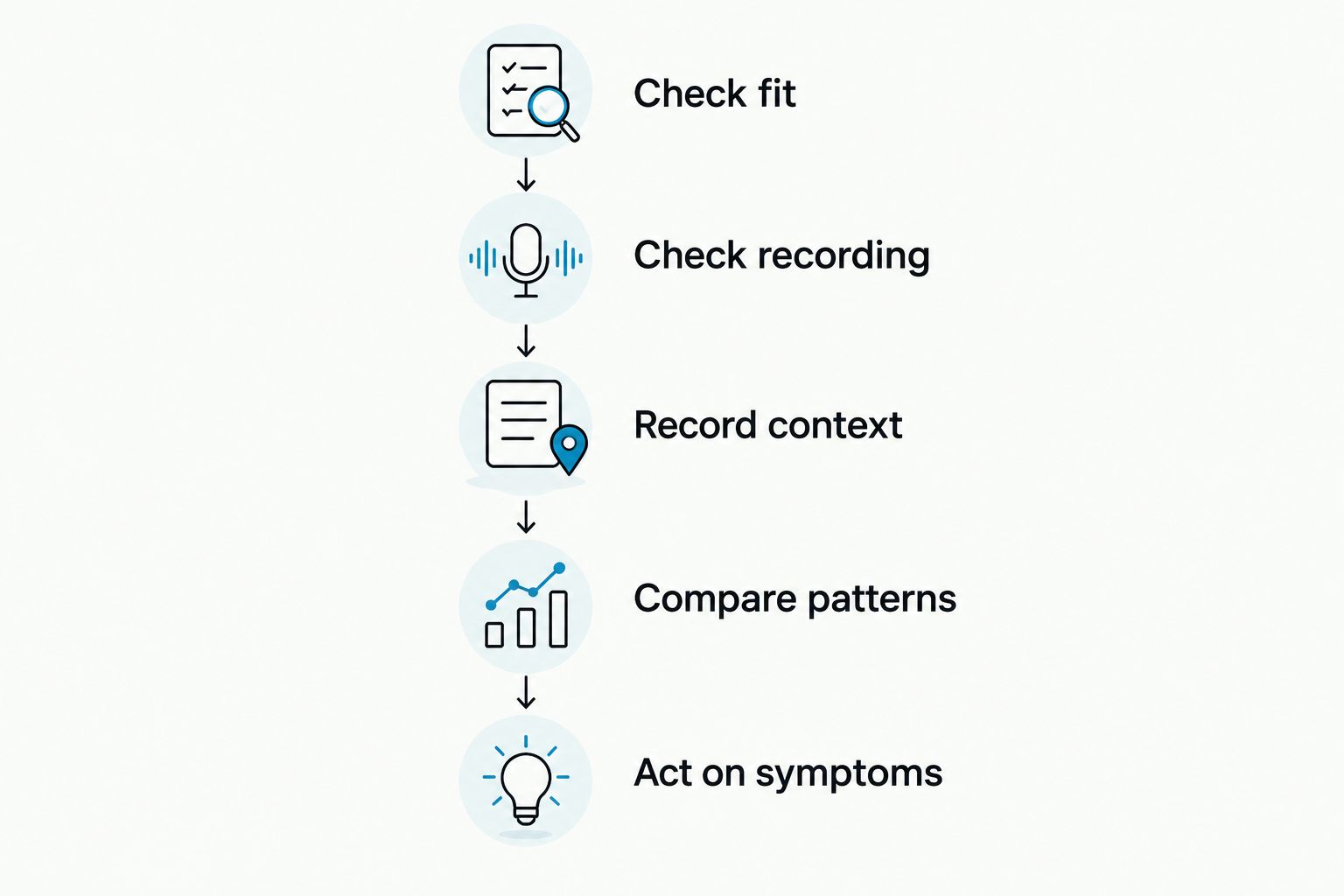
- Check fit. Wear the ring as directed and assess whether it stays comfortably in place overnight. Do not accept painful tightness for the sake of tracking.
- Check recording. Charge the ring, wear it through the intended sleep period and review whether the app shows an incomplete night.
- Record context. Note bedtime, waking time, remembered awakenings and how rested you feel. Keep the notes independent of the score.
- Compare patterns. Look for repeated agreement or disagreement between the summary and your notes. Avoid treating one unusual night as a conclusion.
- Act on symptoms. Bring persistent sleep concerns to a clinician, even when the app reports reassuring results.
Keep your interpretation specific. “The ring recorded a shorter night when I went to bed later” is a narrower observation than “the ring measures all my sleep accurately.” The first describes what you noticed; the second requires evidence beyond a personal comparison.
Is a sleep tracking ring as accurate as a sleep study?
A sleep tracking ring is not a substitute for a clinical sleep study. Polysomnography records signals used for clinical assessment that a consumer ring does not collect in the same way.
A ring's advantage is convenient recording during ordinary nights at home. Its limitation is that estimated wellness data cannot answer every clinical question about breathing, sleep stages or the cause of disrupted sleep.
Does wearing a ring every night make it more accurate?
Consistent wear creates a more complete personal record, but it does not establish a higher accuracy percentage. Repeating a measurement does not remove a systematic classification error.
The useful benefit is continuity: you have more nights to compare with your schedule and notes. You still need to distinguish a recurring pattern from proof that every measurement is correct.
Can sleep tracking make your sleep better?
Sleep tracking records information; it does not by itself prove an improvement in sleep. A ring can give you a prompt to review your routine, but reporting a better score is not the same as demonstrating better health.
For Odessaring, the supported promise is access to estimated wellness insights without monthly fees. Improved sleep, clinical-grade accuracy and medical benefits require separate evidence and are not promises to attach to the product.
Frequently asked questions
What's the most useful way to read a sleep ring's accuracy claim?
Read an accuracy claim by metric, device and study population. Sleep detection, wake detection and sleep-stage classification are different outcomes, so one percentage cannot describe them all.
Is a ring that detects sleep correctly also good at detecting wakefulness?
Good sleep detection does not establish good wake detection. In de Zambotti and colleagues' 2019 study of 41 healthy adolescents and young adults, the evaluated Oura ring had 96% sleep sensitivity and 48% wake specificity.
Does Oura research prove that Odessa is accurate?
Oura research does not establish Odessa Smart Ring accuracy. Results apply to the device, software, measurements and participants evaluated in the particular study.
Can I use a sleep ring to diagnose sleep apnea?
Do not use the Odessa Smart Ring to diagnose sleep apnea. Its wellness readings are estimates and are not intended to diagnose, treat or monitor a medical condition; discuss suspected sleep apnea with a clinician.
Will Odessa work with my iPhone or Android phone?
The free QRing app supports iPhone and Android. Check the current app requirements against your phone before purchasing, rather than assuming every handset or operating-system version is supported.
How long does the Odessa battery last?
The client-confirmed battery specification is 5–7 days per charge. Charge before a planned recording period so an empty battery does not leave part of the night unrecorded.
Can I return Odessa after sleeping in it?
The client-confirmed return promise is 60 days, with worn rings accepted. Customer-paid change-of-mind return postage applies, and free size exchanges are offered within 60 days; request clarification if live policy wording conflicts.
One last thing
A believable-looking chart is not the same as a validated measurement. For your 2026 decision, choose subscription-free tracking if you want an accessible record of estimated sleep patterns, then judge its practical value alongside comfort, consistent wear and your own notes.
Odessaring offers that subscription-free format. Keep the boundary clear: use the ring to organize everyday observations, and use qualified medical care to investigate persistent sleep concerns.