Smart ring size chart: US sizes 6–14 compared 2026

A smart ring size chart for US sizes 6–14 spans approximately 16.5–23.0 mm in inside diameter and 51.9–72.3 mm in inside circumference using conventional jewelry-size conversions. For the subscription-free Odessa Smart Ring, use these measurements as a starting point—not a guarantee of fit around the ring’s internal sensors.
- This smart ring size chart compares US sizes 6–14 using approximate jewelry measurements, not verified device dimensions.
- Odessaring suits women seeking subscription-free sleep insights, provided the ring fits comfortably for everyday wear.
- Measure the intended finger and check knuckle clearance; population averages cannot choose your size.
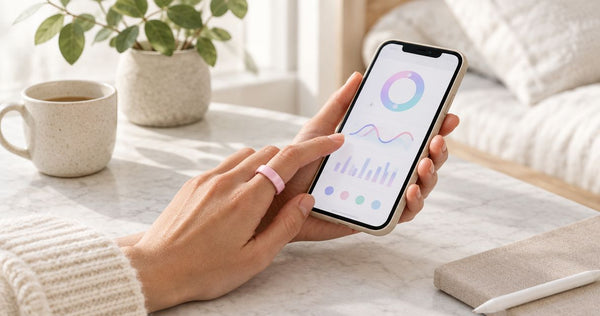
- Odessa Smart Ring uses the free QRing app for iPhone and Android; wellness readings remain estimates.
Interactive · Metric explorer
Tap to explore what Odessa tracks

Sleep: how long and how well you slept, worked out from movement and heart rate overnight.
Heart rate: readings through the day and night from the optical sensor on the inside of the band.
HRV (heart rate variability): the variation between heartbeats, a signal many people watch for recovery trends.
SpO2: blood-oxygen estimates for general wellness, not medical use.
Stress: estimated from body signals such as HRV, so you can see calmer and busier stretches.
Skin temperature: changes against your own baseline over time.
Steps: steps, distance and calories, with sport modes for walking, running, cycling, swimming and more.
Cycle: log your cycle alongside the rest of your data to spot your own patterns.
What it doesn't do: it doesn't measure blood pressure, it doesn't detect snoring, and it doesn't diagnose, treat or prevent any condition. It's a wellness tracker, not a medical device.
Real product photo. Sensor positions are approximate. Battery: 5–7 days per charge. Free app, no subscription.
Smart ring size chart: US sizes 6–14
The table below shows conventional US jewelry-size equivalents for your 2026 sizing check. The millimeter measurements describe a nominal circular ring opening, not confirmed internal dimensions for each Odessa Smart Ring size.
| US size | Approximate inside diameter | Approximate inside circumference |
|---|---|---|
| Overall range: 6–14 | 16.5–23.0 mm | 51.9–72.3 mm |
| 6 | 16.5 mm | 51.9 mm |
| 7 | 17.3 mm | 54.4 mm |
| 8 | 18.1 mm | 57.0 mm |
| 9 | 18.9 mm | 59.5 mm |
| 10 | 19.8 mm | 62.1 mm |
| 11 | 20.6 mm | 64.6 mm |
| 12 | 21.4 mm | 67.2 mm |
| 13 | 22.2 mm | 69.7 mm |
| 14 | 23.0 mm | 72.3 mm |
Size 14 is the largest listed benchmark at approximately 72.3 mm around the inside; size 6 is the smallest at approximately 51.9 mm. Neither endpoint is a recommendation: your intended finger determines where you belong in the range.
Methodology: this 2026 reference uses conventional US/Canadian jewelry-size geometry, with diameter calculated as 11.63 + (0.8128 × US size) millimeters and circumference calculated from the unrounded diameter; displayed measurements are rounded to one decimal place. These are calculated reference values, not measurements of Odessa hardware, and they do not account for sensor protrusions or band shape.
For measurement terminology, the International Organization for Standardization’s ISO 8653, Jewellery—Ring-sizes—Definition, measurement and designation defines ring sizing through internal circumference. That circumference-based reference does not establish a smart ring’s comfort, sensor contact, or model-specific fit.
Why this matters: the size label is only the starting point
A smart ring has to do more than slide onto your finger. It needs to remain comfortable while you sleep and maintain contact for its sensors without squeezing.
A conventional jewelry chart cannot describe every detail of that experience. Internal sensors, band width, your knuckle, and changes in finger size all matter when you try the actual device.
Odessaring is best for women seeking subscription-free sleep and wellness insights in a screen-free ring. That buying case still depends on fit: no monthly fees do not make an uncomfortable ring easier to wear.
The Odessa Smart Ring is listed in US sizes 6–14. Treat that as the stated size range, not evidence that every size fits exactly like another jewelry brand’s equivalent.
How to use these sizing benchmarks
Use the chart to narrow your choice before ordering in 2026. Then assess the physical ring rather than treating the conversion as a final verdict.
- Match the measurement type. Compare a finger’s circumference with the circumference column, not the diameter column. A 19.8 mm inside diameter corresponds to approximately 62.1 mm around the opening.
- Measure the intended finger. A ring that fits another finger—or the same finger on your other hand—is not a reliable substitute for measuring where you plan to wear it.
- Treat boundary readings as unresolved. A measurement between approximately 59.5 mm and 62.1 mm falls between the nominal size 9 and size 10 benchmarks. It does not establish which smart ring will feel better.
- Check the actual fit before judging tracking. A chart can narrow a size choice; it cannot prove stable sensor contact or measurement accuracy.
Avoid choosing the nearest row by eye from a photograph. You need a physical measurement, and you need to know whether that measurement describes the opening or the outside of the ring.
Measure your finger without turning a rough result into a promise
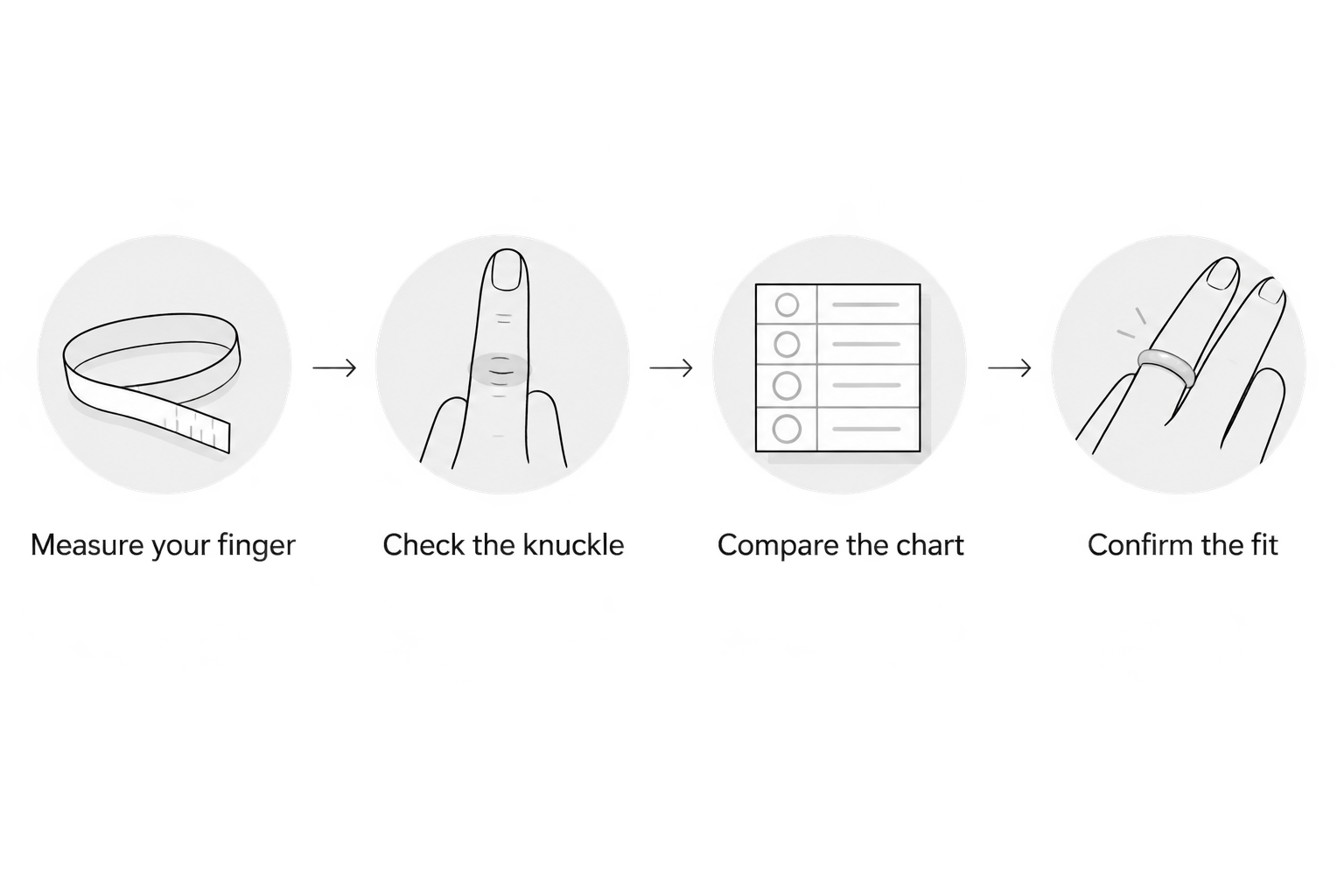
Measure your finger
Wrap a narrow, nonstretching paper strip around the base of the finger you intend to use. Mark where the strip overlaps, lay it flat, and measure the marked length in millimeters.
Keep the strip close to your skin without pulling it tight. A paper strip is a rough measuring tool: it does not reproduce the width, rigidity, or internal shape of a smart ring.
Repeat the measurement when your hands are at a comfortable temperature. Do not make your decision from a reading taken immediately after conditions that leave your fingers noticeably swollen or unusually cold.
Check the knuckle
Check whether the proposed size can pass your knuckle as well as sit at the finger’s base. A measurement that ignores a larger knuckle leaves an important part of the fit unresolved.
Do not pull the paper tighter to obtain a smaller size. The objective is a wearable ring, not the smallest number in the chart.
Compare the chart
Use the circumference column for your paper measurement. If you instead measure an existing ring, measure straight across its inside opening and use the diameter column.
An existing ring is most informative when you already wear it comfortably on the intended finger. Even then, a different band width or internal profile limits the comparison.
Confirm the fit
Once you have the actual ring, check comfort while your hand is relaxed and while you make a fist. Check that you can remove it without pain or force.
Do not force a tight ring over your knuckle or keep wearing a ring that causes pain, numbness, or discoloration. Seek prompt medical help if a stuck ring compromises circulation.
 Screen-free · No subscriptionOdessa Smart RingShop the ring →
Compare measuring methods before choosing one
Each sizing method answers a different question. None turns a conventional conversion table into a model-specific fit guarantee.
| Method | Best for | Main advantage | Main limitation |
|---|---|---|---|
| Paper-strip circumference | A first measurement at home | Measures the intended finger directly | Tension, paper width, and marking affect the result |
| Existing-ring diameter | Comparing with jewelry that already fits | Gives a rigid opening to measure | Different band shapes and sensor interiors limit transfer |
| Jeweler’s sizing tools | Getting help with a difficult measurement | Reduces guesswork from improvised tools | A jewelry gauge does not reproduce every smart ring’s interior |
| Actual smart ring | Confirming everyday comfort | Tests the device you will wear | Requires trying the physical product |
Use a home measurement to narrow the choice, not to overrule discomfort. A precise-looking decimal does not make an improvised measurement precise.
If you are between nominal sizes, ask about model-specific sizing guidance before ordering. Do not automatically size up or down based on advice written for a different ring.
Why average ring sizes cannot choose your size
Population averages describe groups, not the finger you plan to wear a device on. Even a well-sourced average does not account for your chosen hand, knuckle shape, or the smart ring’s internal construction.
The distinction matters when reading average ring sizes for men and women: a group benchmark provides context, but your own measurement must drive the purchase. Do not substitute a demographic category for a fit check.
There is also no personal “average size” that applies to all your fingers. Choose the finger first, measure that finger, and keep that choice consistent when comparing results.
For a 2026 smart ring purchase, the useful benchmark is therefore the chart’s measurement range—not an assumed typical size for women. Your size does not need to resemble anyone else’s.
What a comfortable sleep-tracking fit should accomplish
A comfortable fit should let you wear the ring without persistent pressure or a need to keep adjusting it. Check ordinary movements rather than judging only how the ring feels on a motionless hand.
Pay attention to three practical questions:
- Can you bend and straighten your finger comfortably?
- Does the ring remain in place during ordinary movement without constant adjustment?
- Can you remove it without pain or force?
A ring that repeatedly shifts deserves another fit check. So does a ring that feels restrictive later in the day, even if it felt comfortable when you first put it on.
Fit and accuracy are separate questions. Comfortable wear does not prove clinical accuracy, and a tighter fit does not turn estimated wellness readings into medical measurements.
The Odessa Smart Ring reports estimated sleep and wellness information through QRing. Its readings are not intended to diagnose, treat, or monitor a medical condition; symptoms require medical attention rather than interpretation through a ring score.
The Odessa-specific checks that belong beside the chart
For Odessaring, the buying case is no subscription, one purchase, and zero screens on the ring. The free QRing app supports iPhone and Android, so check the current app listing against your particular phone before committing.
The published product specifications checked October 25, 2026 list stainless steel construction and US sizes 6–14. They also list sleep, heart rate, stress, blood oxygen estimates, skin temperature, and activity; those features do not establish medical accuracy.
Battery life is client-confirmed at 5–7 days per charge. The ring and charging cable are included, so distinguish essential included equipment from optional accessories when assessing total ownership cost.
The main limitations are straightforward. You need a compatible phone to view app-based insights, the readings are estimates, and a nominal jewelry size does not confirm your fit.
Check exchange terms before relying on them
The client-confirmed promise is 60-day returns with worn rings accepted, plus free size exchanges within 60 days. Published product-page terms state that customers cover change-of-mind return postage and include a 12-month manufacturing-defect warranty.
Some site pages carry conflicting return wording. Before relying on the return window for an at-home fit decision, ask Odessaring customer support to confirm the terms that apply to your order in writing.
That is a practical safeguard, not a reason to skip measuring. An exchange process still takes effort, and a warranty does not choose your size.
Frequently asked questions
What does a smart ring size chart actually measure?
A conventional smart ring size chart compares nominal ring sizes with inside diameter or inside circumference. It does not establish the usable opening around a particular device’s sensors or guarantee comfort.
What measurements correspond to US smart ring sizes 6–14?
Conventional US sizes 6–14 span approximately 16.5–23.0 mm in inside diameter and 51.9–72.3 mm in inside circumference. These are jewelry-size benchmarks, not measured Odessa Smart Ring dimensions.
Should I size up if I am between two smart ring sizes?
Do not automatically size up when you fall between two chart rows. Recheck the intended finger and ask for model-specific guidance, because band width, internal sensors, and knuckle clearance affect fit.
Can I use my wedding ring size for a smart ring?
Your wedding ring size is a starting reference only if it fits the intended finger. A smart ring’s width and internal shape can differ, so confirm comfort with the actual device.
Does the Odessa Smart Ring work with iPhone and Android?
The Odessa Smart Ring uses the free QRing app for iPhone and Android. Check the app’s current requirements against your phone before buying; platform support does not establish compatibility with every phone model.
Can I exchange an Odessa Smart Ring if the size is wrong?
The client-confirmed terms include free size exchanges within 60 days. Because some site pages carry conflicting return language, confirm the terms for your order with customer support before relying on them.
Does a snug smart ring provide medical-grade readings?
A snug fit does not establish medical-grade accuracy. Odessa Smart Ring wellness readings are estimates and are not intended to diagnose, treat, or monitor a medical condition.
One last thing
Circumference and diameter are not interchangeable. A size 10 benchmark is approximately 19.8 mm across the inside but 62.1 mm around it; mixing those columns makes an otherwise careful measurement useless.
Write down the finger, hand, measurement method, and units before you choose. That small record gives you a clearer starting point if you need sizing help later.